
Understanding Python Variables and Data Types: A Complete Guide
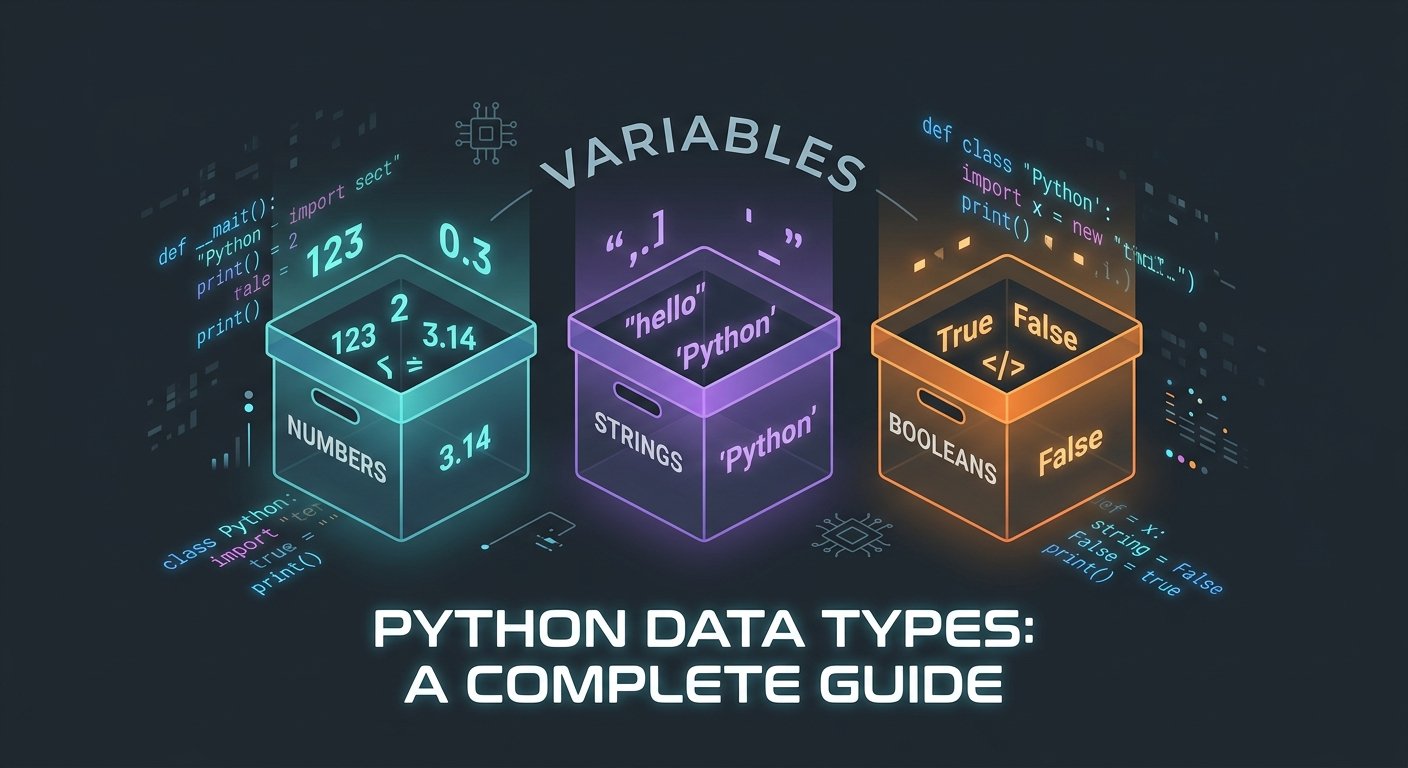
Every program you write relies on storing and manipulating data. In Python, variables act as named containers that hold values, while data types define what kind of data those variables contain. Mastering Python variables and data types is the fundamental first step toward writing efficient, bug-free code.
Unlike lower-level languages, Python handles variable creation and type assignment dynamically, making it intuitive for beginners while remaining powerful for complex applications.
Key Takeaways
- Variables in Python are created automatically the moment you assign a value using the
=operator. - Python uses dynamic typing, meaning you do not need to declare variable types explicitly.
- Core built-in data types include Integers, Floats, Strings, Booleans, Lists, Tuples, and Dictionaries.
- You can check any variable’s data type using the built-in
type()function. - Typecasting allows you to convert values from one data type to another safely.
What Are Variables in Python?
A variable in Python is a symbolic name that points to an object stored in the computer’s memory. Think of a variable as a labeled box where you can store data for later use.
Python
# Creating variables in Python
site_name = "eduzik.com"
user_count = 1500
is_active = True
In the example above, site_name, user_count, and is_active are variables storing a string, an integer, and a boolean value respectively.
Rules for Naming Python Variables
To keep your code readable and prevent syntax errors, follow these standard naming conventions:
- Variable names must start with a letter or an underscore (
_). - Variable names cannot start with a number.
- Names can only contain alphanumeric characters and underscores (
a-z,A-Z,0-9, and_). - Variable names are case-sensitive (
age,Age, andAGEare three different variables). - Avoid using Python reserved keywords like
class,def,if, orimport.
Built-In Python Data Types Explained
Python classifies data into several built-in categories. Knowing which data type to use ensures your programs process data accurately.
1. Numeric Types: Int, Float, Complex
Numeric data types store mathematical values.
- Integer (
int): Whole numbers without decimals (e.g.,10,-5,1000). - Float (
float): Numbers containing decimal points (e.g.,10.5,3.14159). - Complex (
complex): Numbers with a real and imaginary part (e.g.,2 + 3j).
Python
x = 10       # int
y = 3.14     # float
z = 1 + 2j   # complex
2. Text Type: String (str)
A string is a sequence of characters enclosed inside single ('...') or double ("...") quotation marks.
Python
greeting = "Welcome to Python!"
course = 'Python Basics'
3. Boolean Type (bool)
Booleans represent one of two values: True or False. They are vital for conditional statements and program logic.
Python
is_passed = True
has_errors = False
4. Sequence Types: List, Tuple, Range
Sequences let you store multiple items in a single variable.
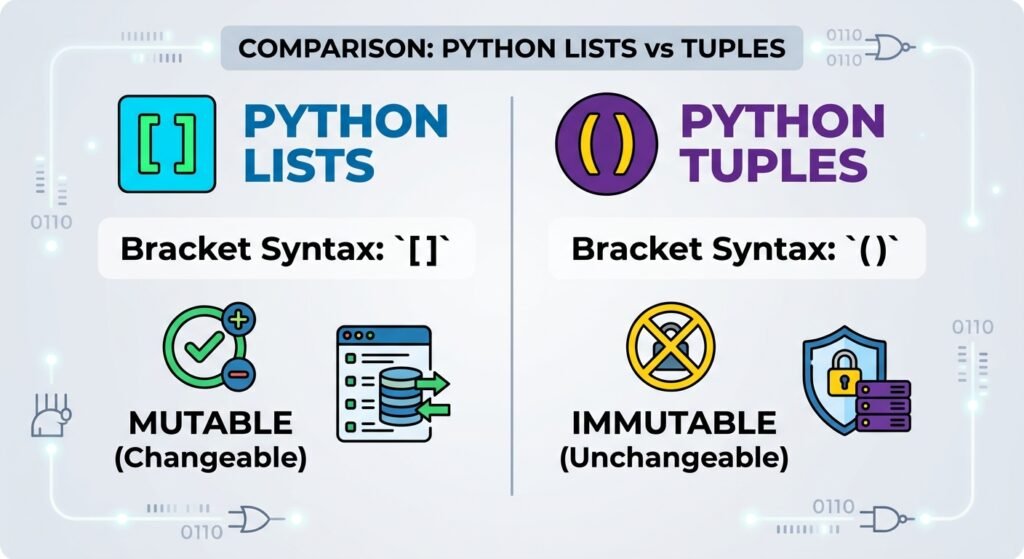
- List (
list): Ordered, mutable (changeable) collection.Pythonskills = ["Python", "HTML", "CSS"] - Tuple (
tuple): Ordered, immutable (unchangeable) collection.Pythoncoordinates = (1920, 1080)
5. Mapping Type: Dictionary (dict)
Dictionaries store data in key-value pairs inside curly braces {}.
Python
user_profile = {
    "username": "coder123",
    "role": "student",
    "level": 1
}
Checking and Converting Data Types (Typecasting)
Finding a Variable’s Type
Use the type() function to inspect the data type of any variable:
Python
score = 95.5
print(type(score))  # Output: <class 'float'>
Typecasting Examples
Typecasting converts a value from one data type to another:
Python
# Converting float to int
price = 19.99
round_price = int(price)  # Output: 19

# Converting int to string
age = 25
age_str = str(age)        # Output: "25"
Conclusion
Understanding Python variables and data types provides the groundwork for building any Python application. By mastering how variables store memory references and selecting the appropriate data type—whether a simple integer or a structured dictionary—you ensure your code is efficient, scalable, and easy to maintain.
Frequently Asked Questions
What is dynamic typing in Python?
Dynamic typing means Python automatically detects a variable’s data type at runtime based on the value assigned to it, without requiring explicit type declarations.
What is the difference between a List and a Tuple in Python?
Lists are mutable (their items can be changed, added, or removed), whereas Tuples are immutable (their contents cannot be modified after creation).
How do I check the data type of a variable in Python?
Pass the variable into the built-in type() function, such as type(my_variable), to output its exact class type.