

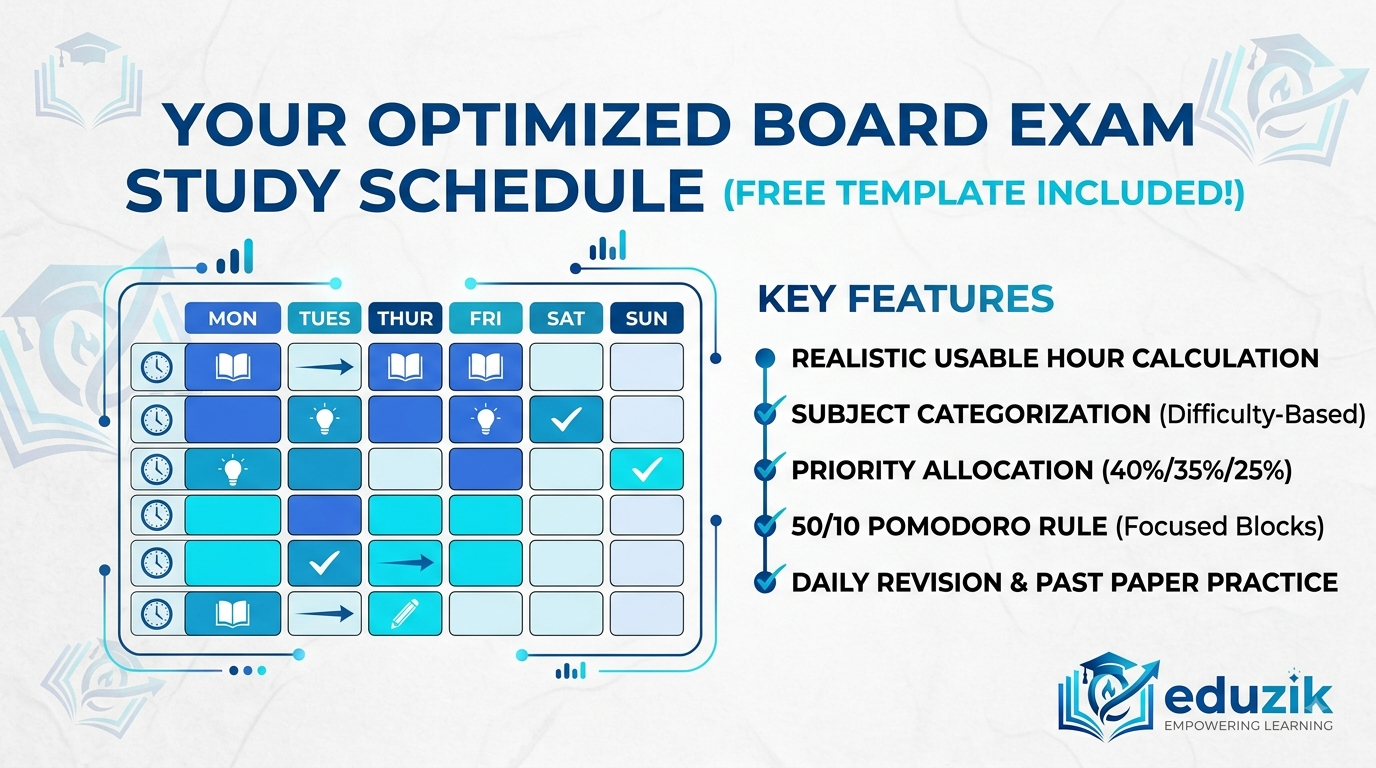
Preparing for board exams can feel overwhelming, but a well-structured study schedule turns confusion into clarity. Whether you have six months or just 30 days left, having a balanced timetable ensures you cover the entire syllabus without burning out.
In this guide, you will learn how to build a personalized study schedule that actually works, along with a free customizable template.
Step 1: Calculate Your Available Study Hours
Before creating a routine, calculate how much time you genuinely have each day.
- Deduct time spent sleeping (7–8 hours), eating, school/coaching, and short breaks.
- Be realistic: If you have 5 usable hours, plan for 4 hours of focused study and 1 hour of buffer time.
Step 2: Categorize Your Subjects by Difficulty
Not all subjects require equal attention. Divide your subjects into three categories:
- High Priority (Difficult/Weak Subjects): Allocate 40% of your daily study time here.
- Medium Priority (Moderate Understanding): Allocate 35% of your time.
- Low Priority (Strong Subjects/Revision Only): Allocate 25% of your time.
Step 3: Implement the 50/10 Pomodoro Rule
Studying continuously for hours reduces focus and memory retention. Use structured study blocks:
- Study with 100% focus for 50 minutes.
- Take a complete 10-minute break (walk around, stretch, hydrate—avoid scrolling on social media).
Daily Board Exam Study Schedule Template
| Time Slot | Activity | Focus Area |
| 06:30 AM – 08:00 AM | High-Focus Session | Hardest Subject (e.g., Physics/Math) |
| 08:00 AM – 02:00 PM | School / Classes | Active Listening & Note-Taking |
| 04:00 PM – 05:30 PM | Medium-Focus Session | Secondary Subject (e.g., Chemistry/Biology) |
| 06:00 PM – 07:30 PM | Active Recall Practice | Solving Past Papers & Quiz Practice |
| 08:30 PM – 09:30 PM | Light Revision | Formulas, Vocabulary & Daily Summary |
Key Takeaways for Success
- Prioritize Consistency: Studying 4 hours every day is far better than studying 12 hours once a week.
- Track Your Progress: Cross off topics on your syllabus syllabus tracker daily to maintain momentum.